Building experimental models of the human brain
Human brain development depends on interactions among many cell types organised across space and time. Two-dimensional cultures are powerful for many questions, but they cannot fully reproduce the architecture and multicellular environment of developing tissue.
Our lab uses several complementary 3D systems, including stem cell-derived organoids, multicellular assembloids and ex vivo human fetal brain cerebroids. Each model offers different strengths, allowing us to choose the system that best matches the biological question.
- Cortical and hippocampal organoids
- Human fetal brain cerebroids
- Assembloids incorporating microglia and vascular cell types
- Models of the developing choroid plexus
- Single-cell, imaging and functional analysis of 3D neural tissue
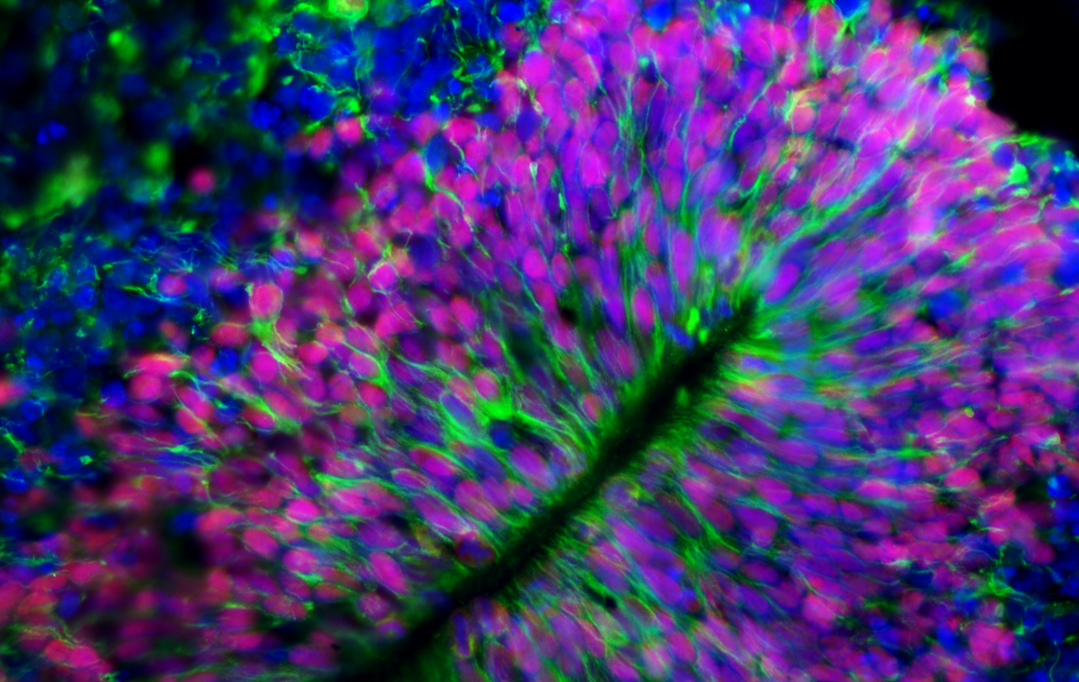
Human cortical organoid labelled for neural stem cell markers, illustrating the organised progenitor zones that can emerge in 3D culture.
Cerebroids
Preserving native human tissue organisation
Our cerebroid platform uses small pieces of developing human brain tissue maintained ex vivo in three dimensions. This approach preserves native cellular diversity and aspects of tissue architecture while allowing controlled experimental perturbation.
We have used cerebroids to examine how inflammatory signals influence neural stem cells and cortical organisation. Because the system retains cell types that are absent from many conventional organoids, it can reveal tissue-level effects that would otherwise be missed.
M. Z. K. Assir et al. Modeling maternal immune activation in 3D ex vivo human fetal brain cerebroids reveals IL-17A-driven disruption of cortical development. Nature Neuroscience, 2026. View publication
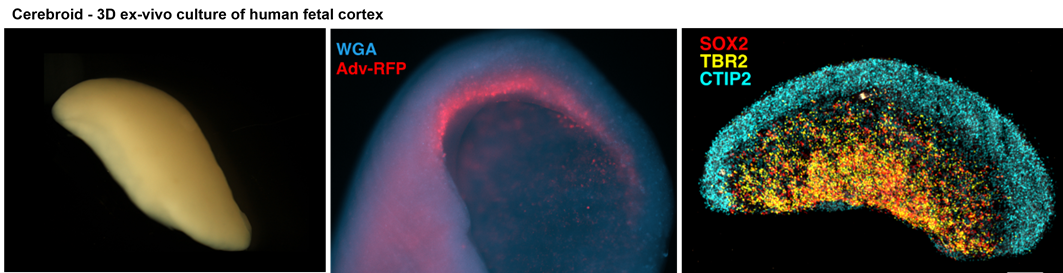
Human fetal brain cerebroids provide a complementary model to stem cell-derived organoids.
More complete multicellular models
We are also interested in bringing additional cell types into 3D neural models. Microglia, endothelial cells and perivascular cells contribute to brain development, tissue remodelling and responses to inflammation, yet they are often missing from standard organoid systems.
By incorporating these components, we aim to build models that better represent the cellular interactions of the developing and ageing human brain and that can be used to test mechanisms of disease.
Related research